
Truganina spans the Wyndham–Melton boundary and is really two suburbs. North and east it is new residential estates with standard double garages. West and south it is a major logistics precinct. We coat both, and they are not the same job.
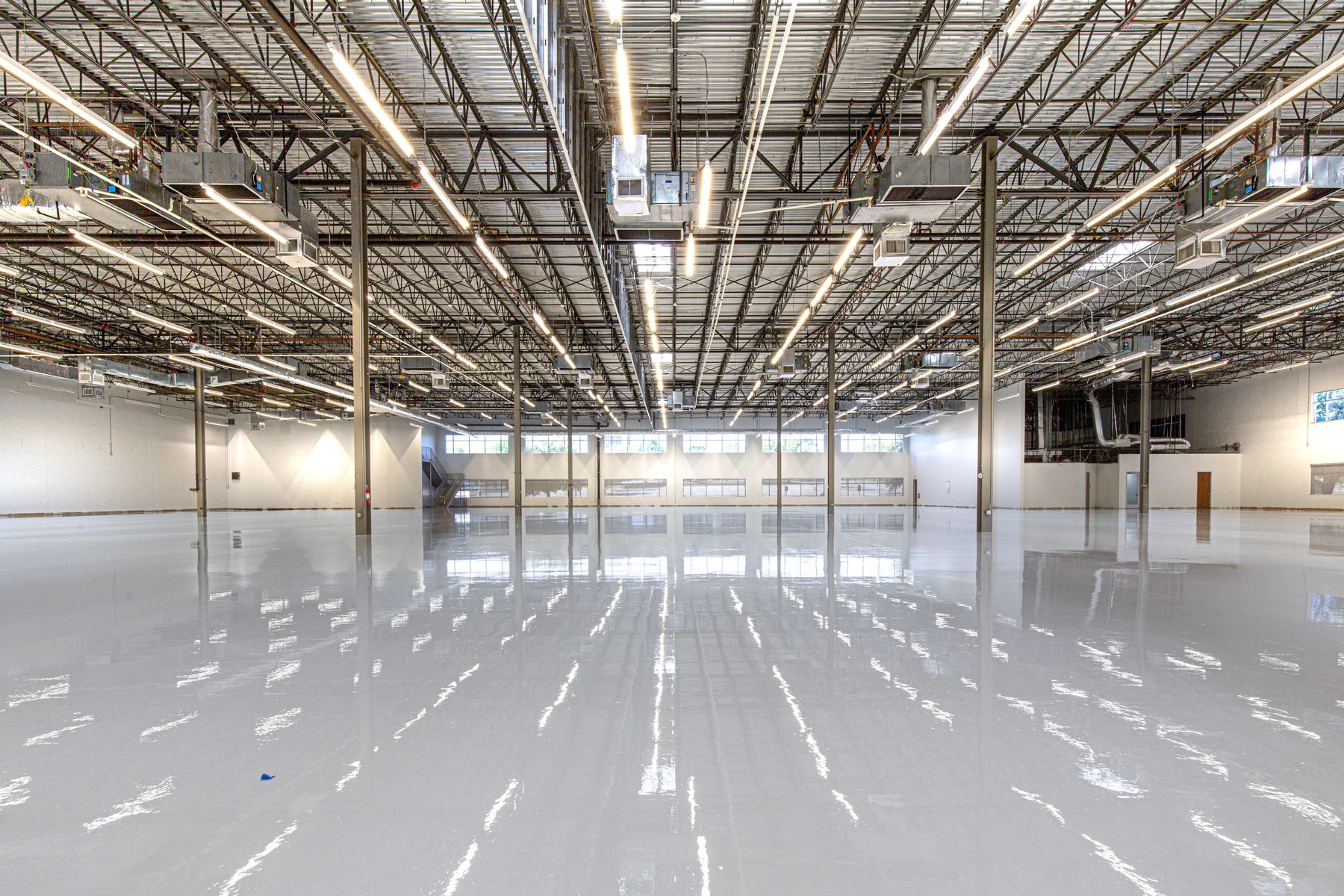
Floor shown is a visualisation — stock reference photography, not a completed Ironclad job.
The residential half — Elements, Allura, Truganina Fields and, over the Melton boundary, Mount Atkinson — is recent construction on the basaltic Werribee plain. The Truganina precinct structure plan alone provided for around 9,400 homes from 2013, so much of the stock is barely a decade old. That brings the same question as neighbouring Tarneit: how old is the concrete? Manufacturers generally want a slab at least 28 days old, and we moisture test rather than assume.
Two local ground conditions are worth knowing. Groundwater through the area sits shallow — commonly in the order of five to ten metres — and an urban floodway zone runs a minimum of a hundred metres either side of Skeleton Creek and Dry Creek. Neither stops a garage floor being coated. Both are reasons we test a slab rather than assuming a new build is automatically dry.
The industrial half is a different animal. Truganina has a formally planned employment precinct, and the warehousing through it sits on thick, power-floated slabs. A burnished commercial slab is one of the harder surfaces to bond to — power-floating closes the surface off, so it looks like a perfect canvas and is nearly the opposite. Acid-etching does not open it enough to matter. Diamond grinding does, which is why the prep is the whole job on a warehouse floor.
The other difference is that a warehouse is usually still trading. Commercial work can be staged bay by bay so you keep operating — racking area by racking area, or aisle by aisle — rather than shutting the building. That has to be planned into the quote, not discovered on the day.
Post-2005 estates. Double garage around 36 m². Slab age is the first question.
Warehouse, distribution and light industrial slabs — power floated, and able to be staged bay by bay so you keep trading.
New residential slabs still curing, or dense burnished commercial slabs with forklift traffic and tyre marking.
Same four stages on every job in Truganina, residential or commercial. No shortcuts, because we're the ones carrying the guarantee.
Diamond-ground back to bare, open concrete. Not acid-etched, not rolled over. Dust-extracted, so the garage stays clean.
Moisture tested before a drop goes down. Cracks and joints are cut out and filled so they don't telegraph through the finish.
Pigmented base coat, then decorative flake broadcast to refusal for full coverage, grip and depth. Your colour, chosen before we arrive.
Clear coat over the top, edges cut in sharp, site cleaned. You get the guarantee in writing before we leave.
One day on site. Walk on it after 24 hours, car back on it at 48. Gear moved and put back — you don't lift a thing. Written guarantee against lifting, and it transfers if you sell.
Truganina is on our regular Wyndham run, so residential scheduling is simple. Commercial is a different conversation and usually starts with when the building is empty enough to work in.
For a warehouse or workshop we will want to know the floor area, the traffic on it (foot, pallet jack, forklift), whether you need line marking or bay demarcation, and how much of the floor can be out of service at once. Out-of-hours and weekend staging is normal on this kind of work.
For a residential job in one of the newer estates, the usual estate caveats apply — narrow streets, limited kerb space, and construction traffic in stages that are still being built out.
Usually, yes — we stage it. The floor gets done in sections so part of the building keeps working while another part is off limits. How fast that goes depends on your layout, your racking and how much space you can clear at a time, so we plan it with you before quoting rather than after.
It is the opposite. A power-floated or burnished slab has a closed, dense surface with almost nothing for a coating to key into, and acid-etching does not open it anywhere near enough. It has to be mechanically ground back to open concrete. A coating that looks perfect on a burnished slab on day one is the classic delamination story.
Both. Flake broadcast to refusal gives you a hard-wearing textured surface that hides marking, which suits workshops and trade counters. Plain colour with demarcation suits warehouse traffic lanes. Tell us what the space is for and we will spec it.
More general questions are answered on the main FAQ, and Melbourne-wide answers — cost, systems, timing — live on the epoxy flooring Melbourne page.
One photo and rough dimensions is all we need to give you a real number — no site visit required. Quotes weekdays 7am–7pm.
Get my price →